What Is Glass? Structure, Composition and the Glass Transition
Is glass a solid or a liquid? Understand its non-crystalline structure, the glass transition and why composition matters more than appearance.
Updated 19 October 2026
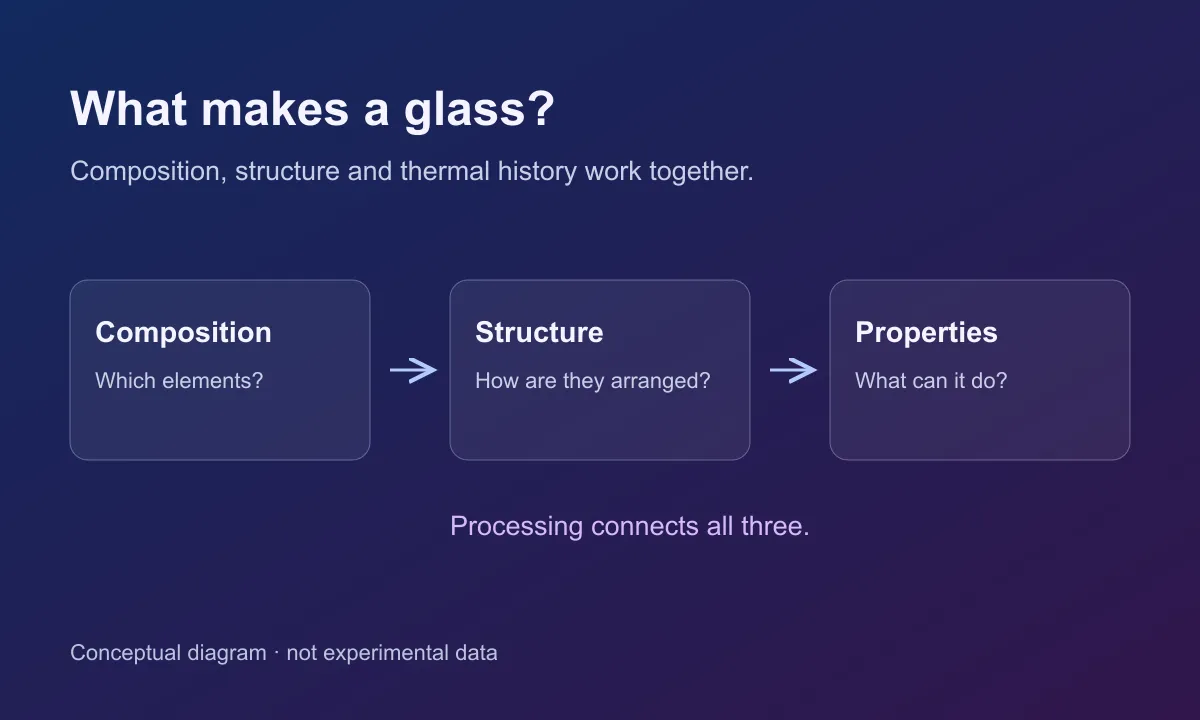
Glass is a non-crystalline material: its atoms do not form the repeating, long-range arrangement found in a crystal. On everyday timescales, a window or a glass lens behaves as a rigid solid. What makes glass scientifically interesting is that its structure also records how it was made and cooled.
Calling glass a “frozen liquid” captures part of this story, but misses the distinction between atomic arrangement, mechanical behavior and thermodynamic equilibrium. Those are different questions.
Is glass a solid or a liquid?
For handling a lens, designing a window or measuring a sample, treating glass as a solid is appropriate. For understanding its structure and long-term relaxation, the picture needs more detail. Glass is out of equilibrium, and its structure can evolve with time and temperature.
Zanotto and Mauro’s discussion of the glassy state makes this dependence on timescale explicit. The practical lesson is to state the conditions. “Does it flow?” is incomplete without a temperature and an observation time. It is not a useful reason to describe an ordinary window as a liquid in everyday life.
What happens at the glass transition?
During cooling of a glass-forming melt, structural rearrangement becomes progressively slower. If crystallization is avoided, the material can enter a glassy state. Around the glass-transition region, its response changes between a relatively rigid glass and a more mobile supercooled liquid.
The glass transition is different from the melting of a crystal. A reported glass-transition temperature, often written Tg, is associated with a measurement procedure and thermal history. When comparing two values, check how the samples were heated or cooled and how Tg was identified. A number without that context is a weak basis for choosing a processing temperature.
Is all glass made of sand?
Silica is central to familiar window glass, but “glass” describes a much wider family of materials. Oxide glasses can use silicate, borate or phosphate networks. Other glass families use different chemistry altogether.
The composition determines which structural units can form and which additional elements the material can accommodate. In our perspective Glass: Home of the Periodic Table, we explored how this compositional freedom supports very different functions. A glass can be a transparent host, a light-emitting material or a platform for nanoparticles. These are designed properties, not automatic consequences of being non-crystalline.
Why two clear glasses can behave differently
Imagine two polished, colorless samples on a laboratory bench. Their appearance alone tells you little about their thermal expansion, chemical durability or behavior during heat treatment. Even “transparent” needs a wavelength range and a thickness.
A useful comparison starts with four questions:
- What is the chemical composition?
- What thermal and processing history did the sample experience?
- Which property is required, and under what conditions?
- What measurement would demonstrate that the requirement is met?
This is the starting point for connecting composition → structure → processing → properties. It also explains why replacing one glass with another is rarely just a question of matching the color.
For the optical side of the story, continue with why glass is transparent. For materials that intentionally contain crystals, read the introduction to transparent glass-ceramics.