Transparent Glass-Ceramics: How Crystals and Clarity Can Coexist
What are glass-ceramics, and why can some remain transparent? Explore controlled crystallization, light scattering and the trade-offs in stronger optical materials.
Updated 16 October 2026
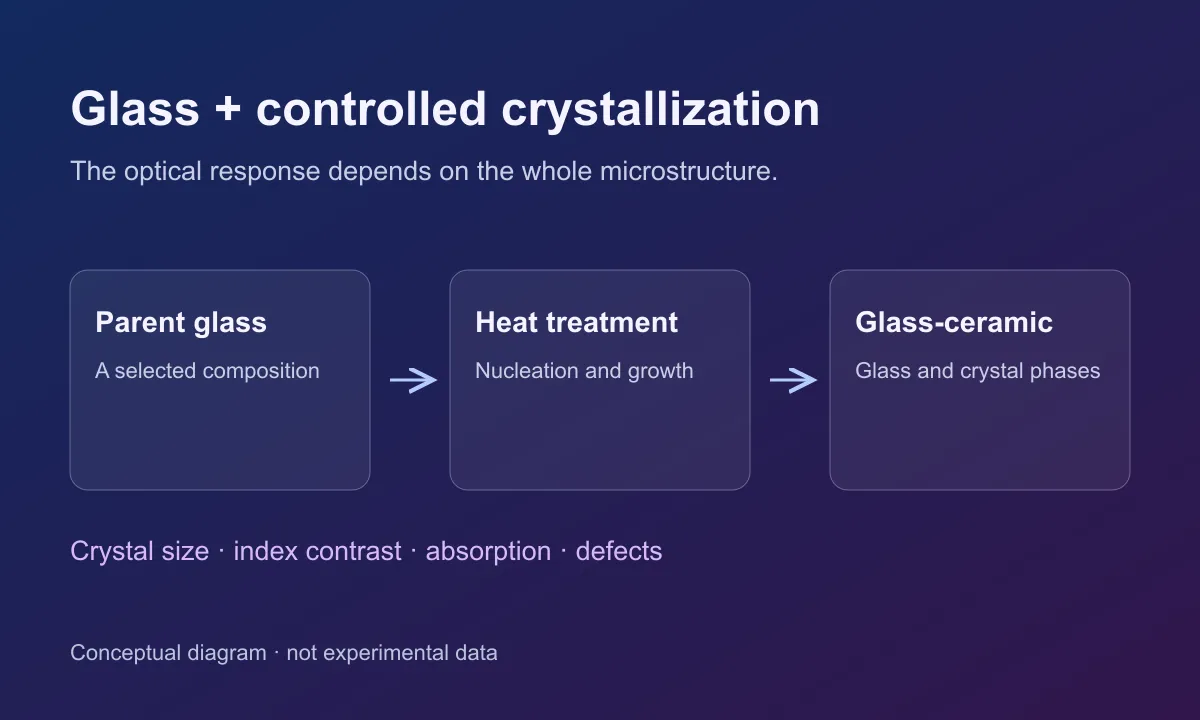
A glass-ceramic contains crystalline phases produced through controlled crystallization of a parent glass. It can combine a residual glass matrix with crystals chosen for a particular function. Some glass-ceramics are opaque; others remain sufficiently transparent for optical applications.
This is not a contradiction. Crystals do not automatically make a material opaque. The key questions are how much light the material absorbs and how strongly its internal structure scatters that light.
How is a glass-ceramic made?
A common route begins with a glass of a suitable composition. Heat treatment then promotes the formation of crystal nuclei and their subsequent growth. Composition, nucleating agents and the time–temperature schedule influence the resulting phases and microstructure.
The important word is controlled. Accidental crystallization can spoil a glass component. In a glass-ceramic, crystallization is part of the intended process. Corning’s account of glass-ceramic development provides an accessible introduction to that distinction.
Why do crystals sometimes scatter light?
Light encounters variations in refractive index as it travels through a composite material. The contrast between crystal and glass, the size of the crystals and their spatial arrangement all matter. Pores and other defects can contribute additional scattering.
Hendy’s analysis of transparent glass-ceramics shows why a single crystal-size threshold is too simple. Transparency depends on the microstructure as a whole. Making crystals small compared with the wavelength can help, but it does not remove the need to control absorption, index contrast and defects.
This is also why a photograph is insufficient evidence. A thin sample can look clear while a thicker component shows substantial loss. A useful report specifies thickness, wavelength range and the measurement geometry.
Does crystallization always make glass stronger?
No universal improvement follows from adding crystals. Mechanical performance depends on the phases, their distribution, residual stresses and the flaws from which fracture starts. A harder surface and a higher measured bending strength describe different properties.
Chemical strengthening is another tool. In suitable compositions, ion exchange produces a compressive surface layer that can make surface cracks harder to open. It changes the stress state; it does not make the material unbreakable. Corning’s explanation of ion exchange describes this mechanism.
A study I co-authored, Ultra-Strong Transparent ZnAl₂O₄ Glass-Ceramics via Controlled Crystallization and Ion Exchange, examines the combination named in its title. For the experimental conditions and measured performance, the original paper is the appropriate source; a headline should not be treated as a guarantee for every composition or product.
How should an optical glass-ceramic be evaluated?
Start from the application, then define a comparison that can actually be tested:
- Optical requirement: transmission at the operating wavelength and final thickness, with scattering distinguished from absorption.
- Mechanical requirement: the relevant loading and surface condition, rather than an isolated hardness number.
- Processing requirement: a reproducible heat treatment and a workable finishing route.
- Service requirement: the temperature, humidity and contact conditions the component will encounter.
For a protective optical cover, a gain in mechanical performance is useful only if the optical specification still holds. For a photonic component, preserving clarity may be only the beginning: the crystalline phase may also need to provide an optical function.
Explore my transparent glass-ceramics research, or read how glass is made for the processing context.