Why Does Tempered Glass Shatter into Small Pieces?
How thermal tempering strengthens glass, why stored elastic energy drives fragmentation, and how tempered, heat-strengthened and laminated glass differ.
Updated 9 November 2026
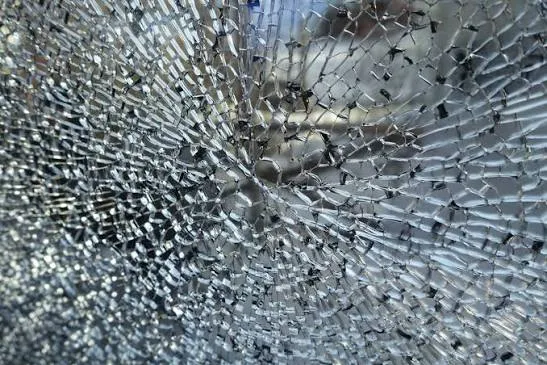
Tempered glass contains surface compression and interior tension. Once a crack reaches the tensile interior, stored elastic energy can drive repeated crack branching, dividing the pane into many small fragments. Stewart and Prakash's study describes this mechanism.
The explanation here concerns fully thermally tempered soda-lime-silica glass, a common type of architectural glass. The word strengthened covers several treatments, so the processing route matters.
How rapid cooling leaves stress inside glass
During thermal tempering, a prepared pane is heated uniformly and then cooled rapidly with air jets. Its surfaces cool faster than its interior. After cooling, compression remains near the surfaces, balanced by tension in the central region. These are residual stresses: stresses present even when no external load is being applied. Guardian Glass explains the heating and quenching process.
The surfaces become rigid before the hotter core. As the core later cools and contracts, the surrounding glass constrains it, establishing the final stress profile. Stewart and Prakash describe this sequence.
For the earlier steps that turn raw materials into a glass sheet, see how glass is made.
Why surface compression makes a pane harder to break
Small surface flaws can act as starting points for cracks. A tensile load tends to open them, while the compressive surface stress introduced by tempering opposes that opening. This raises the applied load needed to initiate fracture from a given surface flaw. The role of surface flaws and the balancing interior tension is discussed in Nielsen's work on stresses in tempered glass.
Greater resistance to surface fracture can therefore coexist with extensive fragmentation.
Where the energy for fragmentation comes from
Energy already stored in the pane can sustain fracture without a continuing external load. The initiating event need not supply all the energy for the subsequent breakup. Stewart and Prakash analyze this self-driven crack branching using dynamic fracture models.
Researchers can observe the process directly. In a study of tempered soda-lime-silica glass, Nielsen, Olesen and Stang measured the initial residual stress state and recorded fragmentation with high-speed cameras. They also examined fracture features using scanning electron microscopy. Their 2009 experimental paper connects the visible breakup of a pane with the development of its fracture surfaces.
Why the fragments do not all have one fixed size
“Small pieces” describes a characteristic pattern, not a universal particle size. Nielsen's analysis of residual stress and strain energy in fragments considers the initial stress state, pane thickness and fragment geometry. Its calculations also show that fragments can retain some stress and elastic energy after breakup.
The useful interpretation is that fragmentation depends on the state of the glass before fracture and on how cracks develop. A description such as “tempered” alone cannot specify the exact size and shape of every fragment.
How does heat-strengthened glass differ?
Heat-strengthened glass undergoes a related heating and cooling treatment, with less intense cooling than fully tempered glass. It develops lower surface compression and generally breaks into larger pieces. Guardian's comparison of the two treatments describes the differences in both strength and breakage pattern.
The cooling history therefore influences two questions: how much load the pane can withstand, and what happens after it fractures. Both matter when describing a glass product.
What does lamination add?
Lamination introduces another feature: an interlayer bonding glass panes together. For example, Pilkington Optilam uses a transparent interlayer, typically polyvinyl butyral, or PVB. After fracture, fragments adhere to that layer, helping to keep the broken pane together. Pilkington's product description explains this construction.
Tempering describes a treatment that changes the stress state within glass. Lamination describes how panes are bonded into an assembly. When discussing a product, ask about the treatment of its individual panes as well as its layered construction. Fragment size and fragment retention are separate properties to consider.
The visible breakup reflects an invisible processing history. Cooling leaves stresses that help resist surface fracture and can subsequently drive fragmentation through the interior.
Sources and further reading
- Stewart and Prakash (2023): Modeling dynamic fragmentation of tempered glass, Engineering Fracture Mechanics.
- Guardian Glass: Heat-strengthened vs tempered glass.
- Nielsen (2017): Remaining stress-state and strain-energy in tempered glass fragments, Glass Structures and Engineering.
- Nielsen, Olesen and Stang (2009): The Fracture Process of Tempered Soda-Lime-Silica Glass, Experimental Mechanics.
- Pilkington: Optilam laminated glass.