How Is Glass Made? From Raw Materials to a Finished Product
Glass manufacturing explained through composition, melting, forming and annealing, with practical questions for diagnosing defects and planning materials R&D.
Updated 16 October 2026
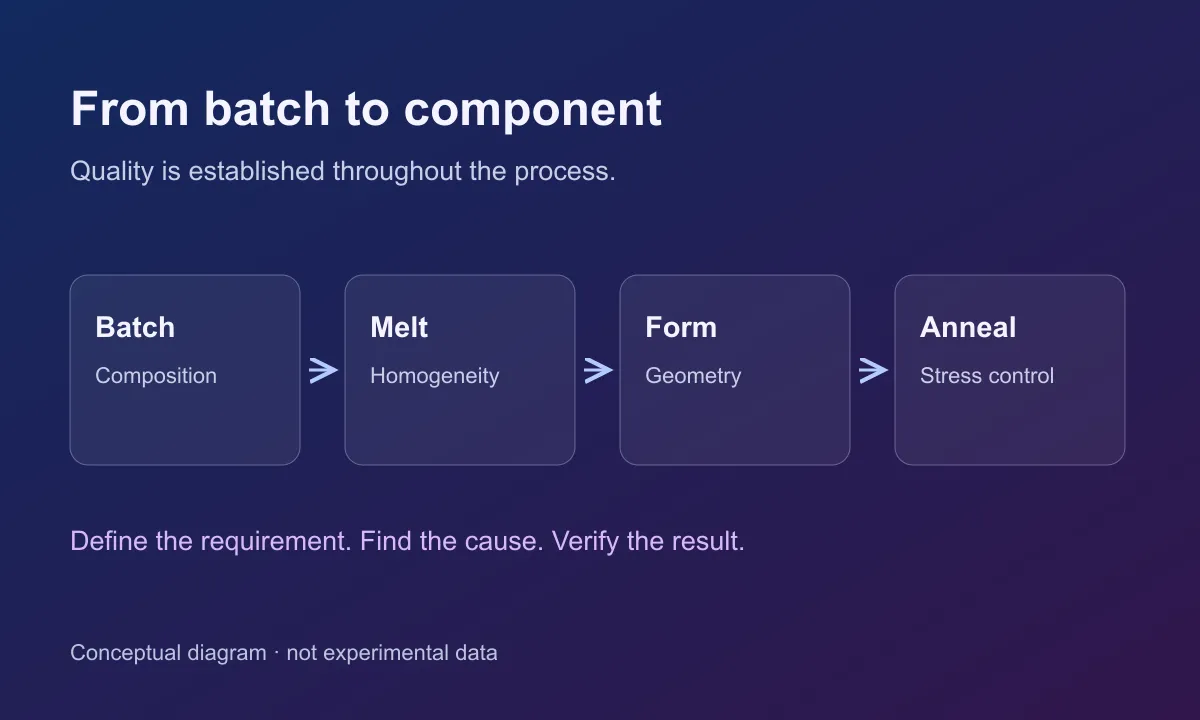
Making glass involves more than melting sand. A manufacturer must turn a controlled composition into a homogeneous melt, shape it and cool it without unacceptable defects or residual stress. Different products require different forming methods, but the connection between composition, processing and quality is common to all of them.
For a scientist working with industry, this chain is also a useful way to locate a problem. A defect seen in the final product may have started several stages earlier.
Start with the composition and raw materials
A glass batch is a measured mixture of raw materials. The familiar float-glass route uses silica-bearing materials together with other ingredients and recycled glass. It is one industrial composition family, not a recipe for every optical or technical glass.
NSG’s overview of the float process shows where raw materials and recycled glass enter the production line. The broader diversity of glass chemistry is described in Glass: Home of the Periodic Table.
For a development project, define the required properties before selecting a composition. Copying a familiar recipe does not establish that it will meet a new optical, chemical or processing requirement.
Melting, refining and homogenization
The furnace must produce a melt that can be formed into an acceptable product. Melting the batch, reducing bubbles and evening out composition are related tasks, but they are not interchangeable.
Pilkington describes these operations as occurring in different zones of a continuous furnace. Its step-by-step float-process guide connects furnace operation to downstream quality. A bubble or an unmelted grain can survive long enough to become a defect in the finished sheet.
This is why “increase the temperature” is not a complete troubleshooting plan. A useful investigation also considers where the defect forms, how the material moves through the process and what changed before the problem appeared.
Forming and controlled cooling
In float production, the melt spreads over a bath of molten tin to form a ribbon. Other glass products require other shaping routes. Even within flat glass, the final specification can require additional coating, cutting or finishing operations.
Cooling is a controlled process too. Annealing reduces residual stresses that would otherwise compromise subsequent handling or cutting. It should not be confused with a later strengthening treatment designed to create a useful stress profile.
For example, ion exchange can place the surface of a suitable glass under compression. Corning’s explanation describes this separate chemical-strengthening operation.
How to investigate a manufacturing problem
Suppose a component has become cloudier after a process change. Before assigning a mechanism, organize the evidence:
- Describe the defect: location, appearance, affected batches and frequency.
- Identify the change: composition, raw-material lot, furnace schedule, forming conditions or finishing.
- Choose discriminating measurements: which observation could distinguish a surface problem from a change inside the material?
- Keep a reference: compare affected and unaffected samples under the same measurement conditions.
- Define success: an agreed optical or mechanical criterion, rather than “looks better.”
These are proposed investigation steps, not a diagnosis for every cloudy glass. They help turn a broad production concern into a research question that can be tested.
From process control to materials development
Sometimes the objective is to preserve a glassy structure. In other projects, a later heat treatment deliberately creates crystals. The latter route leads to glass-ceramics.
The right starting point for cooperation is the product requirement, the current process and representative evidence. My research portfolio shows related work in optical glasses and glass-ceramics; the contact form is a place to describe a specific materials question.