Why Is Glass Transparent? Absorption, Scattering and Color
Why light passes through some glasses, why others are colored or cloudy, and how thickness and wavelength change what transparency really means.
Updated 16 October 2026
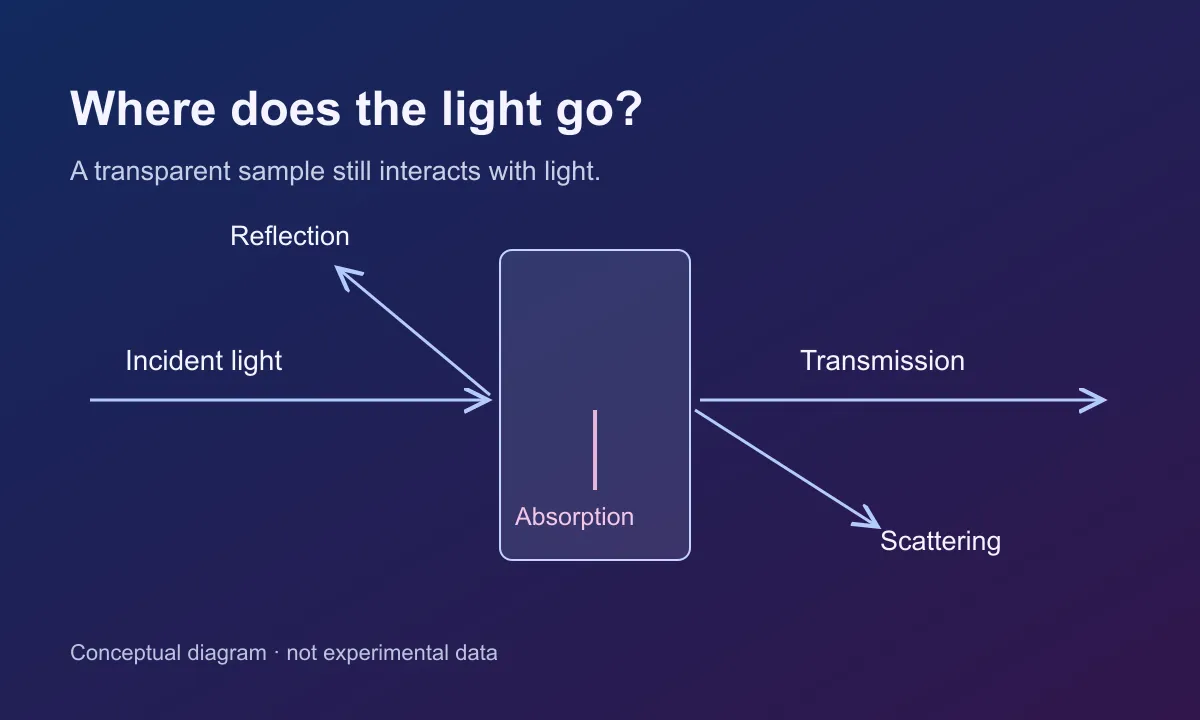
Glass appears transparent when enough visible light passes through it without being absorbed or scattered away from its original direction. Its surfaces still reflect part of the light. Transparency is therefore not the absence of interaction with light; it is the outcome of several competing optical processes.
The phrase “glass is transparent” also needs a qualification: which glass, at which wavelength, and at what thickness? A material that looks clear to the eye may be unsuitable for a UV instrument or an infrared sensor.
Absorption: light energy stays in the material
Absorption removes energy from the transmitted beam. A glass composition has a particular spectral transmission window, and added elements or impurities can introduce additional absorption bands. Some glasses are deliberately designed to absorb selected wavelengths: optical filter glass is an example.
SCHOTT’s optical-filter documentation treats selective absorption as a useful function. A colored glass is not necessarily a defective clear glass. It may be doing exactly the job it was designed for.
This distinction matters when someone asks for “maximum transparency.” An imaging window and a protective spectral filter can require quite different transmission curves.
Scattering: light changes direction
A cloudy appearance can arise when light is redirected by variations within the material or at its surface. A detector that collects only a narrow beam will register scattered light differently from a system that also collects light leaving at other angles.
That is why direct transmission, total transmission and visual haze should not be used interchangeably. A sample may pass a substantial amount of light while failing to preserve a sharp image.
Transparent glass-ceramics make this issue particularly clear. Their optical behavior depends on the size and distribution of crystals and on their refractive-index contrast with the surrounding glass. The glass-ceramics article explains why crystallinity alone does not decide whether a material is transparent.
Why thickness changes the answer
Light traveling through a thicker absorbing material has a longer path over which it can be attenuated. For a homogeneous, weakly scattering sample, internal transmission follows an exponential dependence on thickness. Surface reflection is a separate contribution.
SCHOTT’s technical note on transmission distinguishes these terms. When comparing data, check whether a curve describes internal transmission or the measured transmission through the complete sample. Mixing them can make two identical materials appear different.
A useful comparison keeps wavelength, thickness and surface finish consistent. If those conditions differ, explain the correction instead of simply ranking the curves.
Why nanoparticles can change the color
Nanoscale features can create optical responses that the parent glass does not have. Metal nanoparticles are a particularly striking example: their interaction with light can depend on particle geometry, surrounding material and interactions between particles.
Corning describes several examples of glass as a nanotechnology material. In my research, the broader question is how composition and processing control this optical response. The photonic-glasses research page links to original studies.
A practical checklist for a “transparent” material
Before selecting or testing an optical glass, write down:
- The operating wavelength or spectral interval.
- The thickness and surface finish of the final component.
- Whether preserving an image matters, or only transmitted power.
- Whether coatings, heating or processing will change the optical response.
These details turn a visual impression into a material requirement. They also make an initial research discussion much more productive than asking for a glass that is simply “clearer.”