The Future of Glass: Laser Writing, Photonics and Data Storage
How glass can guide light, host functional nanoparticles and store information—and how to distinguish a laboratory result from a practical photonic device.
Updated 16 October 2026
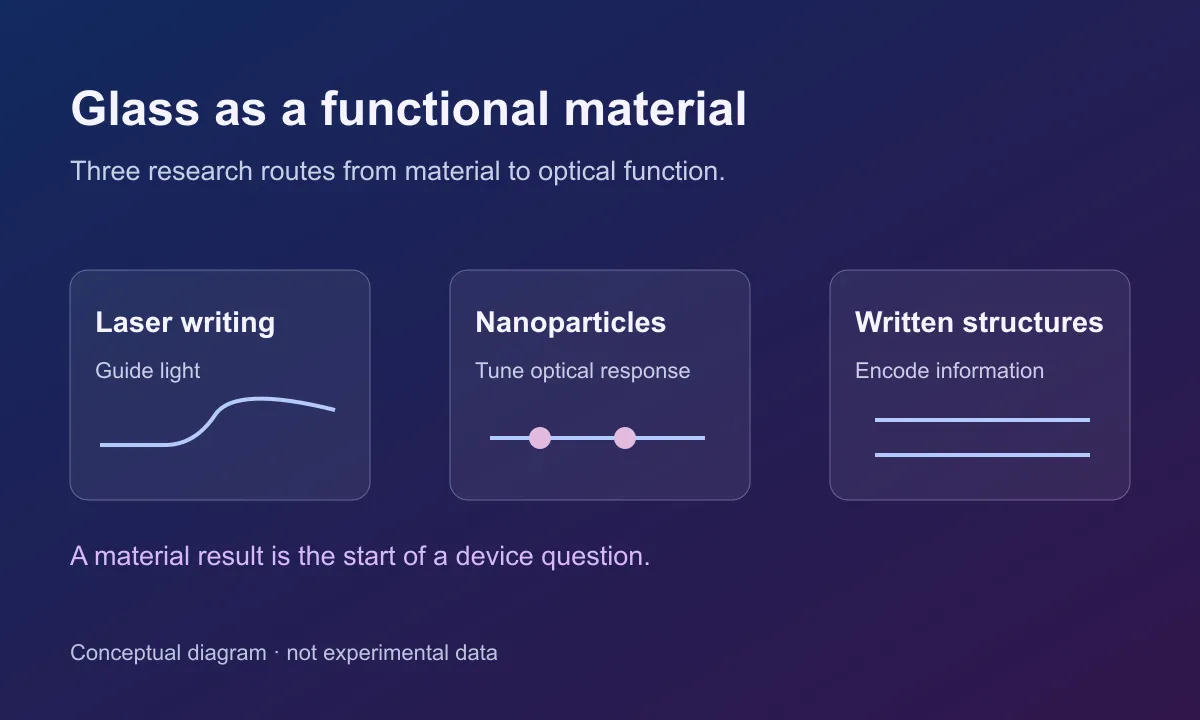
Glass is often treated as a passive material: a window that lets light through or a cover that protects something more interesting. In photonics, the material can also guide light, modify its spectrum or contain structures that encode information.
Three research directions show how this works: writing optical paths with a laser, controlling nanoparticles inside glass and recording data within its volume. Each is supported by experiments. None removes the need to assess performance, reproducibility and integration into a complete system.
Writing an optical path inside a material
Direct laser writing uses focused laser irradiation to modify selected regions. The resulting change can be used to build an optical structure within the material, rather than only on its surface.
In a study I co-authored on lithium aluminosilicate glass-ceramics, femtosecond irradiation locally vitrified crystalline regions. The modified regions had a lower refractive index and formed a surrounding cladding that confined light in a core. The paper reports single-mode guiding at 1064 nm.
That is a demonstrated waveguide in a specified material and geometry. It is not evidence that any glass can be written with the same settings. A new application still needs wavelength-specific loss measurements, coupling to other components and a reproducible fabrication route. My laser-writing research page provides the original publication links.
Changing optical behavior with nanoparticles
A second approach modifies the material at a much smaller scale. Gold nanoparticles in glass can produce a localized surface plasmon resonance: a collective electronic response to light that affects the optical spectrum.
In our 2024 study of gold nanoparticles in zinc aluminosilicate glass, thermal treatment changed the shape and position of the resonance band. Structural characterization and modeling supported an interpretation involving the local arrangement of nanoparticles and phase separation.
For applications, the useful question is what this control enables. A spectral change is an experimental result; improved performance in a laser, sensor or emitting device needs a further experiment. This distinction is central to evaluating a material before promoting a proposed application.
Can glass store digital information?
Yes: information can be encoded in laser-written structures inside glass and recovered optically. The challenge is to make the entire write–read–decode process efficient and reliable, not merely to create a visible mark.
The Microsoft Research Project Silica team’s 2026 Nature paper reports advances in glass-based archival storage. This is a useful example of materials processing being developed together with an information-storage system.
Archival storage has different priorities from a drive that is constantly rewritten. When reading a longevity claim, examine the accelerated-aging method, environmental assumptions and what must remain available to decode the data. A durable medium is one part of a durable archive.
How to evaluate a promising glass technology
A practical assessment can be organized around four questions:
- What was measured? Identify the optical or structural result and its conditions.
- What was inferred? Separate the proposed mechanism from direct observations.
- What is the next application test? Name the experiment that would connect the material to a device requirement.
- What must scale? Consider processing time, uniformity, yield and integration, as well as the best laboratory sample.
This framework keeps an emerging technology interesting without making it sound finished. It also helps a potential collaborator identify a manageable first project: a material, a target function and a measurement that can decide whether the approach is worth pursuing.
For the underlying optical concepts, start with why glass is transparent. To explore related work, visit photonic glasses and research projects.
Sources and further reading
- Lipatiev et al. (2021): Direct laser writing of depressed-cladding waveguides in extremely low expansion lithium aluminosilicate glass-ceramics
- Shakhgildyan et al. (2024): Ultra-broadband plasmon resonance in gold nanoparticles precipitated in ZnO–Al₂O₃–SiO₂ glass
- Microsoft Research Project Silica Team (2026): Laser writing in glass for dense, fast and efficient archival data storage